
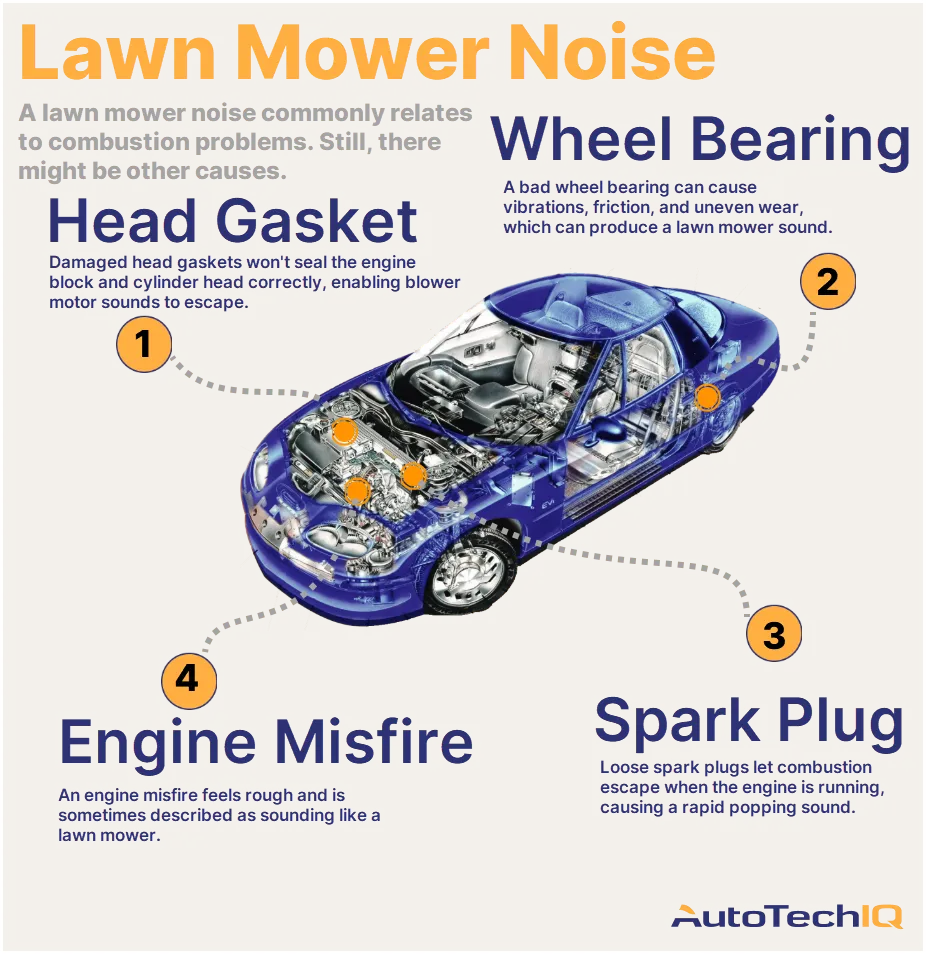
Image Source: www.autotechiq.com
Why Do My Car Sound Like A Lawn Mower?
A car that sounds like a lawn mower often points to issues with the exhaust system, the engine’s combustion process, or worn-out engine components. Common culprits include an exhaust leak, a damaged muffler, a failing catalytic converter, or problems with the engine’s internal workings like sputtering or knocking.
A car that makes a sound similar to a lawn mower can be quite unnerving. That rough, chugging noise is often a sign that something is amiss with your vehicle’s engine or exhaust system. While the sound might seem straightforward, the underlying causes can be varied, ranging from simple fixes to more complex mechanical problems. Let’s dive into the common reasons behind this distinctive sound and what you can do about it.
Deciphering the Lawn Mower Sound: Common Causes
That familiar rumble of a lawn mower, when it emanates from your car, usually signals a disruption in the way your engine is breathing or expelling gases. This abnormal engine sound needs attention.
1. Exhaust Leaks: The Primary Suspect
One of the most frequent reasons for your car sounding like a lawn mower is an exhaust leak. Your exhaust system is a network of pipes, catalytic converters, mufflers, and resonators that carry burnt gases from your engine out of your vehicle. If there’s a hole or crack anywhere in this system, especially before the muffler, the escaping gases can create a loud, choppy, or sputtering sound.
-
Where leaks commonly occur:
- Exhaust Manifold: This is where the exhaust gases first exit the engine cylinders. Cracks here are common due to heat cycles.
- Exhaust Pipes: Connections between pipe sections, or the pipes themselves, can rust and develop holes.
- Flex Pipes: These flexible sections of the exhaust system are prone to damage.
- Gaskets and Clamps: These seals can degrade or loosen over time.
-
The sound of an exhaust leak: An exhaust leak often starts as a subtle ticking or puffing sound, especially when the engine is cold. As the leak grows or the engine revs, it can develop into a much louder, sputtering, or roaring noise, very much like a lawn mower. You might also notice a smell of exhaust fumes inside the cabin, which is a tell-tale sign of a leak.
2. Muffler Damage: The Heart of the Noise Control
The muffler’s job is to silence the noise produced by the engine’s combustion. It uses chambers and baffles to absorb sound waves. If your muffler is damaged, rusted through, or has developed a hole, it can no longer effectively dampen the exhaust noise.
-
Reasons for muffler damage:
- Rust and Corrosion: Road salt and moisture can cause the muffler’s metal to rust and eventually create holes.
- Physical Impact: Driving over road debris or hitting speed bumps too hard can damage the muffler.
- Internal Failure: The baffles or sound-deadening material inside the muffler can break down over time.
-
How a damaged muffler causes the sound: When the muffler is compromised, the raw, loud exhaust gases are released with less restriction, creating a much louder and often deeper rumbling sound, similar to a lawn mower’s engine. A loud exhaust is a direct consequence of a faulty muffler.
3. Catalytic Converter Noise: More Than Just a Sound
The catalytic converter is a crucial part of your exhaust system that converts harmful pollutants into less harmful gases. However, it can also contribute to a lawn mower-like sound if it’s failing or damaged.
-
When catalytic converters cause noise:
- Internal Breakdown: The ceramic honeycomb structure inside the converter can break apart due to age, overheating, or contamination. Loose pieces rattling around can create a distinct metallic noise.
- Clogging: A clogged catalytic converter can restrict exhaust flow, leading to backpressure and an altered engine sound.
- Physical Damage: Like other exhaust components, it can be damaged by impacts.
-
The sound associated with converter issues: While a rattling sound from loose converter material is common, a severely restricted converter can cause the engine to run rough, leading to an unusual exhaust note that might be mistaken for a lawn mower’s drone. This is another instance where an abnormal engine sound can be traced to the exhaust.
4. Engine Sputtering and Misfires: The Internal Struggle
Sometimes, the lawn mower sound isn’t solely an exhaust issue but originates from problems within the engine itself. Engine sputtering is a common symptom of incomplete combustion in one or more cylinders.
-
Causes of engine sputtering:
- Spark Plugs: Worn-out or fouled spark plugs can lead to misfires, where the fuel-air mixture doesn’t ignite properly.
- Ignition Coils: Faulty ignition coils fail to deliver the necessary spark.
- Fuel Injectors: Clogged or malfunctioning fuel injectors can deliver an insufficient amount of fuel.
- Dirty Air Filter: A severely clogged air filter can starve the engine of air, disrupting the fuel-air ratio.
- Vacuum Leaks: Unmetered air entering the engine through a vacuum leak can cause the fuel-air mixture to become too lean.
-
How sputtering sounds like a lawn mower: When an engine misfires, it’s like a cylinder skipping a beat. This uneven firing pattern creates an irregular exhaust pulse, resulting in a choppy, sputtering sound that can be very similar to a lawn mower’s uneven running. This is a direct manifestation of engine sputtering affecting the overall sound.
5. Engine Knocking: A Deeper Mechanical Issue
Engine knocking, also known as detonation or pinging, is a more serious mechanical issue that can also contribute to a lawn mower-like sound. It occurs when the fuel-air mixture in the cylinder ignites prematurely or unevenly.
-
Triggers for engine knocking:
- Low Octane Fuel: Using fuel with an octane rating lower than recommended by the manufacturer.
- Carbon Buildup: Deposits in the combustion chamber can increase compression and create hot spots.
- Overheating Engine: An engine running too hot is more prone to knocking.
- Incorrect Ignition Timing: If the spark plug fires at the wrong moment.
- Faulty Knock Sensor: This sensor is designed to detect knocking and adjust engine timing, but if it fails, knocking can persist.
-
The sound of engine knocking: Engine knocking typically sounds like a sharp metallic pinging or rattling noise, often more pronounced under acceleration. While distinct from a sputtering sound, a severe or persistent knock, combined with other exhaust noises, might be perceived as part of a generally rougher, lawn mower-like engine noise. This is a specific type of abnormal engine sound that requires immediate attention.
6. Belt Noise: A Supporting Actor in the Symphony of Sounds
While not always the primary cause, worn or loose belts in your engine bay can sometimes contribute to unusual noises that might be perceived as part of a broader “lawn mower” sound.
-
Types of belts and their functions:
- Serpentine Belt: Drives accessories like the alternator, power steering pump, and air conditioning compressor.
- Timing Belt (or Chain): Synchronizes the crankshaft and camshaft.
-
How belts cause noise: A worn or frayed belt can slip on pulleys, creating a squealing or chirping sound. A loose belt might flap or slap against other components. While usually a higher-pitched sound, in conjunction with exhaust issues, it could add to the overall rough and noisy character of the car’s operation. This can be considered a type of belt noise.
7. Rattling Under the Car: Loose Components
A general rattling under the car, especially when combined with a rough engine sound, can indicate loose exhaust components or heat shields.
-
Sources of rattling:
- Loose Heat Shields: These metal plates protect the underbody from exhaust heat. If they come loose, they can vibrate and rattle loudly.
- Exhaust Hangers: The rubber or metal hangers that support the exhaust system can break or loosen, allowing the pipes to sag and rattle.
- Catalytic Converter Internals: As mentioned earlier, broken pieces inside a catalytic converter can cause rattling.
-
The effect on the overall sound: A distinct rattling sound from beneath the vehicle, coupled with an uneven engine noise, can certainly contribute to the perception of the car sounding like a lawn mower. This rattling under car is often an accessory to the main problem.
Troubleshooting the Lawn Mower Sound: A Step-by-Step Approach
When you hear that lawn mower sound, it’s important to diagnose the problem accurately. Here’s a general approach:
Step 1: Initial Observation and Listening
- When does it happen? Is the sound present at idle, during acceleration, or when decelerating?
- Where does the sound seem to come from? Front, middle, or rear of the car? Underneath or from the engine bay?
- Are there other symptoms? Smell of exhaust, loss of power, check engine light, rough idling?
Step 2: Visual Inspection (If Safe to Do So)
- Exhaust System: Look for obvious signs of rust, holes, or damage on the exhaust pipes, muffler, and catalytic converter. Check if components are hanging loosely.
- Belts: Inspect the serpentine belt for cracks, fraying, or signs of wear.
- Engine Bay: Look for any loose components or leaks.
Step 3: Identify the Type of Sound
- Deep Rumble/Loud Exhaust: Likely an exhaust leak or muffler issue.
- Sputtering/Choppy Sound: Points towards engine misfires or sputtering.
- Metallic Pinging/Knocking: Suggests engine knocking.
- Rattling: Indicates loose heat shields or exhaust hangers.
Addressing the Common Issues
Let’s break down what needs to be done for each potential cause.
H3: Repairing Exhaust Leaks
An exhaust leak often requires replacing damaged sections of pipe, gaskets, or clamps.
- Minor Leaks: Sometimes, a cracked manifold or pipe can be repaired by welding, though replacement is often preferred for longevity.
- Major Leaks: Damaged pipes, flexible sections, or rusted mufflers usually need to be replaced entirely.
H3: Muffler Replacement or Repair
If the muffler is rusted through or severely damaged, it will need to be replaced.
- Replacement: This is the most common solution for a failing muffler.
- Patching: In some cases, a small hole might be temporarily patched, but this is rarely a permanent fix.
H3: Catalytic Converter Issues
- Replacement: If the catalytic converter is clogged or its internal structure has failed, it must be replaced. This can be an expensive repair.
- Inspection: A mechanic will typically test the converter’s efficiency and check for obstructions.
H3: Engine Sputtering and Misfires
Troubleshooting misfires involves checking the ignition system and fuel delivery.
- Spark Plug Replacement: Regularly replacing spark plugs is part of routine maintenance.
- Ignition Coil Testing/Replacement: Diagnosing and replacing faulty coils.
- Fuel Injector Cleaning or Replacement: Addressing fuel delivery issues.
- Air Filter Replacement: Ensuring adequate air intake.
- Vacuum Leak Repair: Identifying and fixing leaks in the intake system.
H3: Engine Knocking Solutions
Addressing engine knocking requires identifying the root cause.
- Use Correct Octane Fuel: Always use the fuel grade recommended in your owner’s manual.
- Carbon Cleaning: Professional engine cleaning services can remove carbon deposits.
- Knock Sensor Replacement: If the knock sensor is faulty, it will need replacement.
- Ignition Timing Adjustment: This should only be done by a qualified mechanic.
H3: Belt Maintenance
- Belt Replacement: Worn belts should be replaced as part of regular maintenance.
H3: Securing Loose Components
- Tightening: Loose heat shields or exhaust hangers can often be secured with new clamps or bolts.
- Replacement: If hangers are broken, they need to be replaced.
When to Seek Professional Help
While some minor issues can be identified with a visual inspection, most repairs related to a lawn mower sound require a qualified mechanic.
Table 1: When to Call a Mechanic
| Symptom | Likely Cause(s) | Urgency |
|---|---|---|
| Loud exhaust, especially during acceleration | Exhaust leak, muffler damage | High |
| Sputtering or rough running engine | Misfires, ignition issues, fuel delivery problems | High |
| Pinging or knocking sounds | Low octane fuel, carbon buildup, timing issues | Very High |
| Rattling from underneath | Loose heat shields, exhaust hangers | Medium |
| Burning smell in cabin | Exhaust leak, catalytic converter issue | High |
| Check engine light illuminated | Wide range of issues, needs diagnosis | High |
Frequently Asked Questions (FAQ)
Q1: Can I ignore a sound like a lawn mower?
No, it’s generally not advisable to ignore a sound like a lawn mower. It often indicates a problem that can worsen over time, potentially leading to more significant damage or safety issues, such as exhaust fumes entering the cabin.
Q2: Is a loud exhaust always a sign of a problem?
While some performance vehicles are designed to have a louder exhaust note, a sudden or unusual change to a louder sound, especially one resembling a lawn mower, is typically a sign of an issue like an exhaust leak or muffler damage.
Q3: How much does it cost to fix a lawn mower sound?
The cost can vary significantly depending on the cause. A simple exhaust clamp replacement might be under $100, while a catalytic converter replacement can cost $500 to over $2000. Engine repairs for sputtering or knocking can also be costly.
Q4: Can a faulty catalytic converter make my car sound like a lawn mower?
Yes, a damaged or clogged catalytic converter can restrict exhaust flow and cause unusual engine noises, including a rougher exhaust note that might be described as lawn mower-like. Loose internal components can also cause rattling.
Q5: What if I have a rattling under my car and a rough engine sound?
This combination often points to issues with the exhaust system, such as loose heat shields, broken exhaust hangers, or problems within the catalytic converter. It’s important to have this checked by a mechanic.
Conclusion
Hearing your car sound like a lawn mower is more than just an annoying noise; it’s a signal from your vehicle that something needs attention. By familiarizing yourself with the potential causes – from exhaust leaks and muffler damage to engine sputtering and knocking – you can better communicate with your mechanic and ensure your car is running safely and efficiently. Regular maintenance and prompt attention to unusual sounds are key to preventing minor issues from becoming major, costly repairs.