
What is 5000 square feet? 5000 square feet is an area measuring approximately 70.7 feet by 70.7 feet. It’s a common size for a suburban home’s yard, offering a good amount of space for various outdoor activities and landscaping.
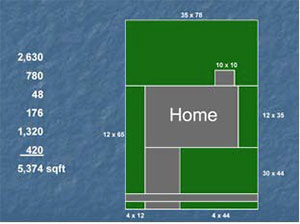
Image Source: ipm.missouri.edu
Grasping the Scale of 5000 Square Feet
Imagine a space that’s 5000 square feet. It’s a considerable area, but how do we truly visualize it? Let’s break it down with comparisons and practical examples to help you picture this size. This isn’t just about numbers; it’s about translating those numbers into something tangible for your backyard size or property footprint.
Acreage Equivalent: Putting it in Perspective
To truly fathom 5000 square feet, it’s helpful to see its equivalent in larger units, like acreage. One acre is a vast 43,560 square feet.
- 5000 square feet is approximately 0.11 acres.
This means 5000 square feet is a little over one-tenth of a full acre. To get a full acre, you’d need to stack up nearly nine of these 5000-square-foot areas. This helps place it within the context of larger land measurements.
Lot Size Comparison: What Does it Mean for Your Home?
Understanding 5000 square feet in terms of your lot size is crucial. Many suburban homes have lots that range from 5,000 to 10,000 square feet or even more.
- A 5000 sq ft lawn means your house and the immediate surroundings take up about a fifth of a quarter-acre lot.
This is a very common size for a single-family home lot in many neighborhoods. It’s large enough to have a decent front yard, a backyard, and space for a driveway and some side yards. It’s not a sprawling estate, but it’s also far from a tiny city plot.
How Much Grass Can You Fit?
The question of “how much grass” depends on your layout. If your entire 5000 square feet were dedicated solely to a lawn, that’s how much you’d have. However, most properties include a house, driveways, patios, and other features that reduce the actual planting area for grass.
- If your house takes up 1500 square feet and your driveway takes up 500 square feet, you’re left with 3000 square feet for your lawn.
This is still a substantial amount of grass to maintain, but it highlights how the house and hardscaping impact the green space.
Visualizing the Dimensions: 70.7 x 70.7 Feet
The most direct way to visualize 5000 square feet is to picture a square. A perfect square with an area of 5000 square feet would measure approximately 70.7 feet on each side.
- Imagine a square with sides about the length of a standard bowling lane (60 feet) plus a bit more.
This gives you a sense of the width and depth of the space.
Relatable Benchmarks for 70.7 Feet
To make 70.7 feet more relatable, let’s use everyday objects and distances:
- Basketball Court: A standard NBA basketball court is 94 feet long and 50 feet wide. 70.7 feet is about three-quarters the length of a basketball court.
- Tennis Court: A doubles tennis court is 78 feet long and 36 feet wide. 70.7 feet is slightly shorter than a doubles tennis court.
- Street Width: The width of a typical residential street can vary, but many are around 30-40 feet wide. So, 70.7 feet is roughly the width of two residential streets placed side-by-side.
- Standard Swimming Pool: An Olympic-size swimming pool is 50 meters (about 164 feet) long and 25 meters (about 82 feet) wide. 70.7 feet is less than half the length of an Olympic pool.
Rectangular Shapes: Other Layouts for 5000 Sq Ft
While a square is the most straightforward, 5000 square feet can also be a rectangle. Here are a few examples:
| Length (ft) | Width (ft) | Area (sq ft) | Description |
|---|---|---|---|
| 100 | 50 | 5000 | A bit longer than a standard 94-ft basketball court. |
| 125 | 40 | 5000 | Similar to the length of a small airplane. |
| 150 | 33.3 | 5000 | About the length of a blue whale. |
| 200 | 25 | 5000 | Roughly the length of a professional soccer pitch width. |
These different shapes demonstrate how the same area can feel and function differently depending on its proportions. A long, narrow 5000 sq ft lot will have a different feel than a more square 5000 sq ft lot.
Practical Implications for Your Property
Now that we’ve visualized the size, let’s consider what 5000 square feet means for the practical aspects of lawn care and landscaping. This size has a significant impact on your backyard size and overall property footprint.
Planting Area Considerations
Your planting area is the portion of your 5000 square feet that will be dedicated to gardens, flower beds, or vegetable patches.
- If you have a 5000 sq ft lawn area, you might allocate 500-1000 sq ft for planting beds.
This is enough space for a substantial vegetable garden, a perennial flower border, or a mix of both. You can create distinct garden rooms, perhaps a small cutting garden or a herb garden near the kitchen.
Mowing Time: How Long Will it Take?
Mowing a 5000 square foot lawn is a manageable task.
- For a typical residential lawn, expect mowing to take between 30 to 60 minutes.
This can vary depending on:
- Mower type: A riding mower will be faster than a push mower.
- Terrain: Sloped or uneven terrain takes longer.
- Obstacles: Trees, flower beds, and garden furniture can slow you down.
- Grass type and density: Thick, dense grass requires more effort.
- Your pace: Some people prefer to take their time.
This is a reasonable amount of time for weekly maintenance for many homeowners.
Fertilization Coverage: Keeping it Healthy
Fertilizing your lawn is essential for a lush, green appearance.
- To cover 5000 square feet with fertilizer, you’ll typically need between 10-20 pounds of granular fertilizer, depending on the product’s application rate.
Always check the instructions on the fertilizer bag. This is a manageable quantity to spread, whether you use a broadcast spreader or a drop spreader. You’ll likely need to do this several times a year for optimal lawn health.
Sprinkler System Needs: Watering Efficiency
Designing a sprinkler system for 5000 square feet requires careful planning to ensure even coverage.
- For a 70.7 x 70.7 ft square lawn, you might need 6-8 sprinkler heads.
Key considerations for your sprinkler system needs include:
- Zone planning: Dividing the lawn into zones based on sun exposure and grass type can improve watering efficiency.
- Head overlap: Ensure sprinkler heads are spaced to overlap their spray patterns, preventing dry spots.
- Water pressure: The water pressure from your source will dictate how many heads can run simultaneously.
- Water conservation: Consider smart controllers that adjust watering based on weather conditions.
Landscaping Scale: Design Possibilities
With 5000 square feet, you have a good canvas for landscaping. The landscaping scale allows for a variety of features.
- You can comfortably fit a patio or deck, a small play area for children, and several mature shrubs or small trees.
Consider:
- Defining outdoor “rooms”: Use landscaping elements to create distinct areas, such as a dining patio, a lounging area, or a play zone.
- Vertical interest: Incorporate trees and taller shrubs to add dimension.
- Hardscaping: Paths, retaining walls, or a water feature can add visual appeal and functionality.
- Focal points: A specimen tree, a sculpture, or a well-placed garden bench can draw the eye.
The 5000 sq ft area provides enough space to create a multi-functional and aesthetically pleasing outdoor environment without feeling cramped.
Fathoming the Property Footprint
Your 5000 square feet represents your property footprint, which is the total area your land occupies. This includes everything within your property lines.
House and Yard Relationship
On a 5000 sq ft lot, the relationship between your house and the yard is quite intimate.
- A typical single-story home might occupy 1200-1800 sq ft of the footprint.
This leaves a significant portion for the yard. The placement of your house on the lot greatly influences the feel of your backyard size. A house centered on the lot might offer equal front and back yard space, while a house pushed to one side could give you a larger backyard.
Beyond the Lawn: Other Features
A 5000 sq ft property footprint might also include:
- Driveway: Usually 200-500 sq ft for a single-car driveway.
- Sidewalks: Connecting the house to the street or different parts of the yard.
- Shed or garage: If detached, these will also consume some of the total area.
- Decks or patios: Outdoor living spaces that are part of the property.
When you subtract all these elements from the total 5000 sq ft, the actual usable lawn or planting area becomes clearer.
Frequently Asked Questions (FAQ)
Q1: Is 5000 square feet a large yard?
A1: 5000 square feet is a good-sized yard for a suburban home. It’s not considered a large estate, but it offers ample space for outdoor living, gardening, and recreation. It’s larger than many urban lots but smaller than most rural properties.
Q2: Can I have a swimming pool in a 5000 square foot yard?
A2: It’s often possible to fit a small to medium-sized above-ground or in-ground pool, but it depends heavily on the shape of your lot, the placement of your house, and local zoning regulations and setback requirements. You’ll need to carefully consider how much space the pool, deck, and any surrounding fencing will take up, and ensure you meet safety codes.
Q3: How much does it cost to maintain a 5000 square foot lawn?
A3: The cost varies greatly based on your choices. DIY maintenance (mowing, fertilizing, watering) will cost primarily for supplies (fertilizer, seed, water) and equipment maintenance. Hiring a professional lawn service could range from $100-$300 per month, depending on the services included (mowing, edging, fertilization, weed control).
Q4: What are the best grass types for a 5000 square foot lawn?
A4: The best grass types depend on your climate and desired maintenance level. Cool-season grasses like Kentucky Bluegrass, Perennial Ryegrass, and Fescues are popular in northern regions, while warm-season grasses like Bermuda, Zoysia, and St. Augustine thrive in the south. Consider low-maintenance varieties if you have limited time.
Q5: How many bags of mulch would I need for 5000 square feet of garden beds?
A5: If your garden beds cover approximately 500 square feet and you want a 3-inch layer of mulch, you’ll need roughly 5 cubic yards of mulch. Standard bags of mulch are often sold in cubic feet (e.g., 2 cubic feet per bag). So, 5 cubic yards is about 135 cubic feet, meaning you’d need around 68 bags of mulch. Always check the volume specified on the bag.
By breaking down 5000 square feet into these relatable terms and practical applications, you can better visualize its scale and what it means for your property and the efforts involved in its upkeep.