
To water your lawn for one inch, the watering duration will typically range from 20 to 30 minutes, but this can vary significantly based on your sprinkler system’s sprinkler output and your specific lawn’s water requirements. Achieving that perfect inch of water is key to a healthy, vibrant lawn, and knowing how long to run your sprinklers is a crucial part of successful lawn irrigation time. This guide will help you decipher the mysteries of effective lawn watering.
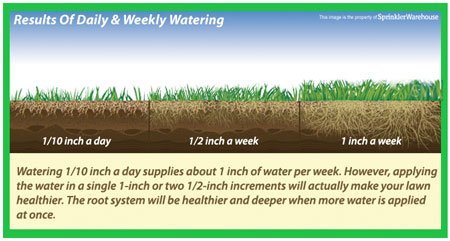
Image Source: school.sprinklerwarehouse.com
Deciphering Your Lawn’s Thirst: The Importance of the One-Inch Benchmark
Why is the “one inch of water” a standard measurement for lawn watering? It’s not an arbitrary number. This amount is generally considered the ideal weekly watering schedule for most established cool-season grasses. It encourages deep watering, which promotes strong, deep root growth. Shallow watering, on the other hand, leads to weak, shallow roots that are more susceptible to drought, disease, and stress. By aiming for that one-inch mark, you are essentially providing your lawn with enough moisture to penetrate the soil to a depth that supports robust root development, contributing significantly to overall lawn health.
Fathoming Your Sprinkler’s Output: The Key to Accurate Watering Duration
The most critical factor in determining how long to water your lawn for one inch is your sprinkler system’s sprinkler output. This refers to how much water your sprinklers actually put out over a given period. Different sprinkler heads have different rates of application. Some might spray a wide area quickly, while others deliver water more slowly and steadily.
Methods to Measure Sprinkler Output
-
The Tuna Can Test (or Similar Container Test): This is the most common and effective method.
- What you’ll need: Several straight-sided containers, like tuna cans, cat food cans, or shallow, uniform measuring cups. Avoid containers with curved sides, as they can skew the results.
- How to do it:
- Place the containers randomly throughout the area your sprinkler is designed to cover.
- Run your sprinkler for a set amount of time (e.g., 15 minutes).
- After the time is up, turn off the sprinkler and carefully measure the depth of water collected in each container using a ruler.
- Average the measurements from all the containers.
- Calculate the sprinkler output in inches per hour. For example, if you collected an average of 0.25 inches of water in 15 minutes, your sprinkler system is applying water at a rate of 1 inch per hour (0.25 inches * 4 = 1 inch).
-
Consulting Manufacturer Specifications: While less precise than the tuna can test, you can often find the application rate of your sprinkler heads in the manufacturer’s documentation. This can give you a starting point, but it’s always best to verify with a real-world test.
Why This Matters for Watering Duration
Once you know your sprinkler’s application rate, you can easily calculate the watering duration needed to apply one inch of water.
- If your sprinkler applies 1 inch per hour: You need to water for 60 minutes.
- If your sprinkler applies 0.5 inches per hour: You need to water for 120 minutes (2 hours) to get one inch.
- If your sprinkler applies 0.25 inches per hour: You need to water for 240 minutes (4 hours) to get one inch.
This highlights why a simple “water for 30 minutes” rule doesn’t work for everyone. The watering duration is directly tied to your system’s efficiency.
Gauging Your Soil’s Capacity: Understanding Soil Moisture
Beyond sprinkler output, your soil type plays a significant role in how well your lawn absorbs water. Different soils have varying capacities to hold moisture.
Common Soil Types and Their Water Absorption
- Sandy Soil: Drains very quickly. It can’t hold much water, so frequent, shorter watering cycles might seem beneficial, but deep watering is still important to encourage roots to go deeper. You might find sandy soils dry out faster.
- Clay Soil: Drains slowly and holds a lot of water. If you water too quickly, water can run off the surface before it has a chance to soak in. This can lead to shallow watering and ineffective irrigation. For clay soils, it’s often better to water for longer periods but less frequently, allowing the water to slowly percolate.
- Loam Soil: This is considered ideal for gardening and lawns. It’s a balance between sand and clay, providing good drainage and good water retention. Loam soils typically absorb water well.
Tools for Checking Soil Moisture
- Screwdriver Test: On a dry day, try pushing a long screwdriver into the soil. If it goes in easily, there’s moisture. If it’s hard to push, the soil is dry.
- Soil Moisture Meter: These electronic devices provide a more precise reading of the soil moisture level. You can insert the probe into the ground to get a reading.
The Art of Deep Watering vs. Shallow Watering
The goal of applying one inch of water is to facilitate deep watering. This means encouraging water to penetrate several inches into the soil, typically 4 to 6 inches deep for most lawns.
Benefits of Deep Watering:
- Stronger Root Systems: Deeply watered grass develops deeper roots. These roots can access moisture further down in the soil profile, making the lawn more resilient during dry periods and less reliant on frequent watering.
- Drought Tolerance: Lawns with deep roots are much better equipped to withstand drought conditions. They can survive longer without rain or irrigation.
- Reduced Weed Growth: Shallowly watered lawns often have a thin canopy of grass, allowing sunlight to reach the soil surface. This creates ideal conditions for weed seeds to germinate and grow. Deep watering encourages a thicker, more competitive turf that crowds out weeds.
- Disease Resistance: Healthy, well-hydrated plants are generally more resistant to diseases and pests.
The Pitfalls of Shallow Watering:
- Weak, Shallow Roots: If you only water the top inch of soil, the grass roots will stay near the surface, making them vulnerable to drying out quickly.
- Increased Weed Invasion: As mentioned, a sparse, shallowly rooted lawn provides ample opportunity for weeds to establish.
- Higher Susceptibility to Stress: Lawns that are shallowly watered are more prone to wilting and browning during hot weather or dry spells.
- Fungal Diseases: Constantly moist surface soil can create an environment conducive to certain fungal diseases.
Optimizing Your Watering Schedule for Peak Lawn Health
A consistent watering schedule is vital for maintaining optimal lawn health. This doesn’t mean watering every single day.
Factors Influencing Your Watering Schedule:
- Grass Type: Different grass species have varying water requirements. For example, fescues generally need more water than some of the drought-tolerant varieties like Bermudagrass.
- Climate: Hot, dry, and windy conditions will increase the rate of evaporation and transpiration, meaning you’ll need to water more frequently than in cooler, more humid climates.
- Season: Water needs change throughout the year. Lawns typically require more water during the summer months when temperatures are high and growth is active.
- Soil Type: As discussed, soil type impacts how quickly water drains and is retained.
- Sun Exposure: Areas of your lawn that receive full sun all day will dry out faster than shaded areas.
Creating an Effective Watering Schedule:
- Water Deeply and Infrequently: Aim to apply that one inch of water, but do it less often. For many established lawns, watering once or twice a week is sufficient, rather than a little bit every day.
- Water in the Early Morning: The best time to water your lawn is between 4 a.m. and 10 a.m. This allows the water to soak into the soil before the heat of the day causes excessive evaporation. Watering in the morning also gives the grass blades time to dry off before evening, which helps prevent fungal diseases. Avoid watering in the evening, as standing water on the grass overnight can encourage disease.
- Observe Your Lawn: Your lawn will tell you when it needs water. Look for signs of stress such as:
- A dull bluish-gray color.
- Footprints remaining visible on the grass long after you’ve walked on it (the blades are not springing back).
- Wilting or curling of the grass blades.
Adjusting for Weather:
- Heatwaves: During periods of intense heat, you might need to increase the frequency of watering or apply slightly more water.
- Rainfall: Always check the weather forecast. If you receive significant rainfall (about a quarter-inch or more), skip your scheduled watering to avoid overwatering. You can use a rain gauge to measure how much rain has fallen.
Putting It All Together: Your Step-by-Step Guide
Let’s synthesize this information into a practical approach to watering your lawn correctly.
Step 1: Determine Your Sprinkler Output
- Perform the tuna can test as described above to accurately measure how much water your sprinklers apply per hour.
Step 2: Calculate the Required Watering Duration
- Formula:
Watering Duration (minutes) = (Desired Water Depth (inches) / Sprinkler Output (inches/hour)) * 60 minutes/hour - Example: If your desired water depth is 1 inch, and your sprinkler output is 0.5 inches per hour:
Watering Duration = (1 inch / 0.5 inches/hour) * 60 minutes/hour = 2 hours = 120 minutes
Step 3: Assess Your Soil Type
- Examine your soil. Is it sandy, clayey, or loamy? This will influence how often you water and how long each watering session should be to achieve deep watering without runoff. If you have clay soil, you might need to apply water in shorter cycles with breaks in between to allow it to soak in.
Step 4: Implement a Smart Watering Schedule
- Water early in the morning.
- Aim for deep watering, applying that one inch of water, but do so less frequently. Once or twice a week is a good starting point for many lawns.
- Adjust your schedule based on weather conditions and your lawn’s visual cues.
Step 5: Monitor and Adjust
- Regularly check soil moisture using a screwdriver or moisture meter.
- Observe your lawn for signs of thirst or overwatering.
- Don’t be afraid to adjust your lawn irrigation time and frequency as needed. Lawn health is an ongoing process.
Common Pitfalls to Avoid
- Watering on a Fixed Schedule Without Consideration: Assuming your lawn needs the same amount of water every week, regardless of rain or temperature, is a recipe for over or underwatering.
- Shallow, Frequent Watering: This is detrimental to root development and overall lawn health.
- Watering in the Heat of the Day: Much of the water will evaporate before it reaches the soil.
- Ignoring Sprinkler System Efficiency: Not knowing your sprinkler output means you are guessing your watering duration.
- Overwatering: This can lead to root rot, fungal diseases, and nutrient leaching.
Innovative Watering Solutions
- Smart Controllers: These Wi-Fi enabled irrigation controllers connect to weather data and can automatically adjust your watering schedule based on local conditions, saving water and ensuring your lawn receives the right amount of moisture.
- Rain Sensors: These devices detect rainfall and prevent your sprinklers from running when they’re not needed.
- Drip Irrigation for Garden Beds: While this post focuses on lawns, remember that other landscaping elements may have different water requirements. Drip irrigation is highly efficient for garden beds.
Frequently Asked Questions (FAQ)
Q1: How do I know if I’m watering my lawn enough?
A: Look for visual cues like a bluish-gray tint, wilting grass blades, or footprints that stay visible on the lawn. You can also use a screwdriver to test soil moisture depth. If it penetrates easily several inches down, your soil is adequately moist.
Q2: Can I water my lawn every day?
A: Generally, no. Watering every day often leads to shallow root systems. It’s better to water deeply and less frequently, allowing the soil to dry out slightly between watering sessions. This encourages roots to grow deeper in search of moisture.
Q3: My sprinklers seem to water unevenly. What can I do?
A: This is a common issue. Ensure your sprinklers are properly adjusted and aren’t clogged. Consider checking the sprinkler head type and placement for optimal coverage. You might need to overlap sprinkler patterns slightly to ensure all areas receive adequate water. The tuna can test can also reveal areas that are getting too much or too little water.
Q4: Is it okay to water my lawn at night?
A: It’s best to avoid watering your lawn at night. While it might seem like you’re saving water from evaporation, the grass blades will remain wet throughout the night, creating an ideal environment for fungal diseases to develop. Early morning is the preferred time.
Q5: How much water does a new lawn need?
A: New lawns, especially those with newly seeded grass or sod, have different water requirements than established lawns. They typically need more frequent, lighter watering to keep the top layer of soil consistently moist, encouraging germination or root establishment. Once the grass is established, you can transition to the deep watering methods described above.
By diligently measuring your sprinkler output, assessing your soil, and adopting a mindful approach to your watering schedule, you can ensure your lawn receives the ideal inch of water it needs for robust growth and lasting lawn health. Happy watering!