
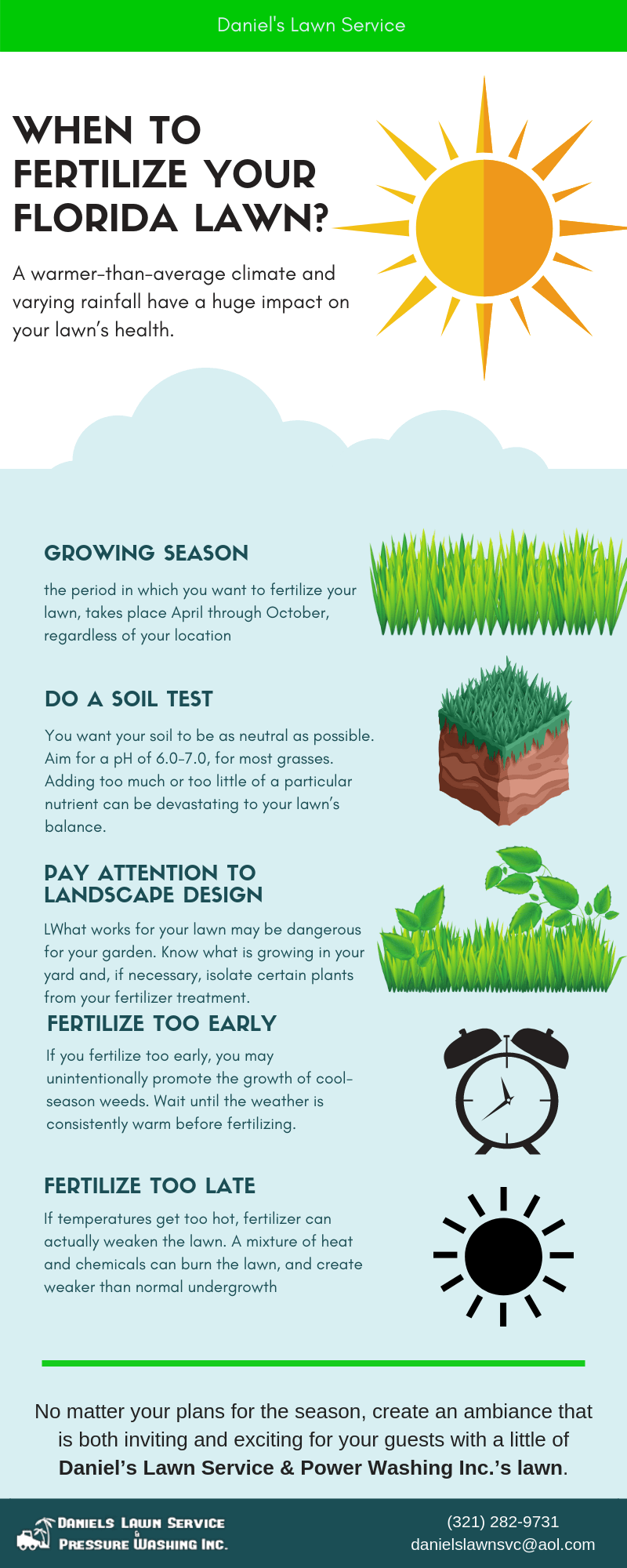
Image Source: danielslawnservice.net
Florida Lawn Care: How Often Should You Fertilize Your Lawn?
A common question for Florida homeowners is, “How often should I fertilize my lawn?” The answer is typically four to five times per year, but this can vary based on grass type, soil conditions, and the specific fertilizer used.
Florida’s unique climate presents distinct challenges and opportunities for lawn care. Understanding when and how often to fertilize is crucial for a healthy, vibrant lawn that can withstand the heat, humidity, and occasional dry spells. This guide will walk you through the essential aspects of fertilizing your Florida lawn, ensuring you provide the right nutrients at the right times.
Why Fertilize Your Florida Lawn?
Your lawn is a living organism that requires nutrients to thrive. Fertilizers provide these essential elements, primarily nitrogen, phosphorus, and potassium, which are vital for:
- Promoting healthy growth: Fertilizers fuel the production of green leaves and strong root systems.
- Increasing disease resistance: A well-fed lawn is better equipped to fight off common lawn diseases and pests.
- Improving color and density: Proper fertilization leads to a lush, green carpet that enhances your home’s curb appeal.
- Recovering from stress: Fertilizers help lawns bounce back from drought, heavy foot traffic, and extreme weather.
The Florida Lawn Fertilizer Schedule: Timing is Everything
Creating a Florida lawn fertilizer schedule is more art than science, influenced by your specific grass type and the time of year. The goal is to feed your lawn when it’s actively growing and can best utilize the nutrients.
Seasonal Lawn Care in Florida
Florida’s seasons are different from many other parts of the country. We don’t experience a harsh winter dormancy. Instead, our growth patterns are more closely tied to temperature and rainfall.
- Spring (March – May): This is a prime time for fertilization as grasses begin their active growth after the cooler months.
- Summer (June – August): While growth is robust, excessive nitrogen can lead to disease issues in the heat and humidity. Fertilization during this period should be approached cautiously.
- Fall (September – November): Another critical period for fertilization, helping the lawn build reserves for the milder winter and prepare for spring growth.
- Winter (December – February): Most lawns slow down significantly. Fertilization is generally not recommended during this time, as it can encourage weak growth that’s susceptible to cold damage.
Best Time to Fertilize Lawn Florida
The best time to fertilize lawn Florida generally aligns with the active growth periods of your grass type. For most warm-season grasses common in Florida, this means spring and fall are the most important fertilization windows.
- Early Spring: As temperatures consistently rise above 65°F (18°C), your lawn will start to green up. This is an ideal time for the first feeding.
- Late Spring/Early Summer: A second application can be beneficial as growth is vigorous.
- Late Summer/Early Fall: This application is crucial for strengthening the lawn before it enters its slower growth phase.
- Late Fall (Optional): Some experts recommend a final, light feeding in late fall to provide nutrients for early spring green-up, but this should be done cautiously and without high-nitrogen formulations.
Fertilizing St. Augustine Grass in Florida
Fertilizing St. Augustine grass in Florida requires a slightly different approach due to its growth habits and susceptibility to certain issues. St. Augustine grass is a popular choice for its lush appearance and shade tolerance.
- Growth Habits: St. Augustine grass grows best in warm temperatures and can be susceptible to chinch bugs and brown patch disease, especially when over-fertilized or stressed.
- Fertilization Frequency: Aim for three to four applications per year.
- Timing:
- Late Spring (April/May): The first application after the danger of frost has passed and the grass is actively growing.
- Mid-Summer (July/August): A moderate application is suitable, but avoid high-nitrogen fertilizers that can push growth too rapidly in the heat.
- Early Fall (September/October): A vital application to help the grass recover from summer stress and prepare for the cooler months.
- Fertilizer Type: Use a slow-release nitrogen fertilizer. Look for formulations with balanced micronutrients, especially iron, which helps St. Augustine grass maintain its deep green color. Avoid high-phosphorus fertilizers unless a soil test indicates a deficiency.
Fertilization Frequency for Bermuda Grass in Florida
Fertilization frequency for Bermuda grass in Florida is generally higher than for St. Augustine grass because Bermuda grass is a vigorous grower and a heavy feeder.
- Growth Habits: Bermuda grass thrives in full sun and high temperatures. It can tolerate drought and heavy traffic but requires regular feeding to maintain its density and color.
- Fertilization Frequency: Aim for four to six applications per year.
- Timing:
- Early Spring (March/April): Once the grass has fully greened up after winter.
- Late Spring (May/June):
- Mid-Summer (July/August):
- Late Summer/Early Fall (September/October):
- Fertilizer Type: Bermuda grass benefits from nitrogen-rich fertilizers. Slow-release nitrogen is still preferred to prevent surge growth and potential burn. Consistent feeding throughout the growing season is key to a dense, healthy Bermuda lawn.
Key Nutrients for Your Lawn
Fertilizers are typically labeled with three numbers, representing the percentage by weight of nitrogen (N), phosphorus (P), and potassium (K).
- Nitrogen Fertilizer (N): This is the most important nutrient for vegetative growth, promoting lush green foliage and dense turf. Too much nitrogen can lead to rapid, weak growth that’s susceptible to disease and drought. Florida lawns generally require a good amount of nitrogen, especially during the active growing season.
- Phosphorus Fertilizer (P): Phosphorus is essential for root development and seedling establishment. While crucial, many Florida soils are naturally high in phosphorus, and excessive application can lead to environmental problems (e.g., algal blooms in waterways). Phosphorus fertilizer Florida regulations often restrict its use unless a soil test confirms a deficiency. Many fertilizers formulated for established lawns omit phosphorus or contain very low amounts.
- Potassium Fertilizer (K): Potassium helps improve the overall health and vigor of the plant, increasing its resistance to stress, diseases, and extreme temperatures. It plays a role in water regulation and root strength. Potassium fertilizer Florida lawns can benefit from, especially during periods of stress like drought or high heat.
Soil Testing for Florida Lawns
Before you start fertilizing, it’s highly recommended to conduct soil testing for Florida lawns. A soil test will provide valuable information about your lawn’s soil pH and nutrient levels.
-
Why Test?
- Accurate Nutrient Needs: Identifies specific nutrient deficiencies or excesses in your soil, preventing over or under-fertilization.
- pH Level: Florida soils are often acidic. The optimal pH for most turfgrasses is between 6.0 and 7.0. If your soil is too acidic or too alkaline, nutrient uptake can be hindered.
- Cost Savings: You’ll avoid wasting money on unnecessary fertilizers.
- Environmental Protection: Ensures you’re not adding excess nutrients that could leach into groundwater or run off into waterways.
-
How to Test: Contact your local University of Florida IFAS Extension office. They provide soil testing kits and analysis, along with recommendations tailored to your specific location and grass type.
Types of Fertilizers for Florida Lawns
Choosing the right fertilizer is as important as knowing when to apply it.
- Slow-Release Fertilizers: These are generally the best choice for Florida lawns. The nutrients are released gradually over time, providing a steady supply for your grass and reducing the risk of “burn” or nutrient leaching. Look for formulations with sulfur-coated urea, polymer-coated urea, or organic nitrogen sources.
- Quick-Release Fertilizers: These provide an immediate green-up but can lead to rapid, weak growth and are more prone to burning the lawn or washing away with heavy rain. They are best used sparingly for specific purposes, like correcting a sudden deficiency.
- Organic Fertilizers: These are derived from natural sources like compost, manure, and bone meal. They improve soil structure over time and release nutrients slowly, offering a more sustainable approach to lawn feeding.
- Synthetic Fertilizers: These are chemically produced and offer precise nutrient ratios. They are often more concentrated and provide faster results but can be more susceptible to causing damage if misapplied.
Applying Fertilizer: Best Practices
Proper application is crucial for effective fertilization and to avoid damaging your lawn or the environment.
- Read the Label: Always follow the instructions on the fertilizer bag carefully. This includes the recommended application rate and any specific safety precautions.
- Calibrate Your Spreader: Ensure your broadcast or drop spreader is calibrated correctly to apply the fertilizer evenly at the recommended rate. Uneven application can lead to stripes of lush growth and bare patches.
- Watering: Water your lawn lightly after fertilizing (unless the product specifies otherwise). This helps move the fertilizer into the soil and reduces the risk of leaf burn. Avoid watering immediately after application if heavy rain is expected, as this can cause runoff.
- Avoid Fertilizing During Drought: Do not fertilize during prolonged dry periods when the grass is stressed. Wait until adequate moisture is available.
- Sweep Up Spills: If fertilizer granules land on sidewalks or driveways, sweep them back onto the lawn immediately. Fertilizer on hard surfaces can be washed into storm drains, contributing to water pollution.
Common Fertilization Mistakes in Florida
- Over-fertilizing: This is a common mistake that can lead to weak, disease-prone grass and environmental damage. Stick to the recommended rates.
- Using the Wrong Fertilizer: Applying a high-phosphorus fertilizer when it’s not needed can be detrimental.
- Fertilizing Dormant Grass: Applying fertilizer when the grass is not actively growing is a waste of resources and can even harm the lawn.
- Ignoring Soil Test Results: Fertilizing without knowing your soil’s needs is inefficient and potentially harmful.
- Applying in Heavy Rain: This greatly increases the risk of fertilizer runoff into storm drains and waterways.
Lawn Maintenance Tips for Florida
Beyond fertilization, consistent lawn maintenance tips Florida residents should follow include:
- Mowing: Mow at the correct height for your grass type, typically higher for St. Augustine grass and lower for Bermuda grass. Keep mower blades sharp to ensure a clean cut, which helps prevent disease.
- Watering: Water deeply and infrequently to encourage deep root growth. Water early in the morning to minimize evaporation and reduce the risk of fungal diseases.
- Weed Control: Address weeds early. Healthy, dense turf is the best defense against weeds, but spot treatment or pre-emergent herbicides may be necessary.
- Pest and Disease Management: Regularly inspect your lawn for signs of pests or diseases and address them promptly with appropriate treatments.
Frequently Asked Questions (FAQ)
Q1: Can I fertilize my lawn in the summer in Florida?
A1: It’s generally advisable to fertilize with caution during the peak of summer. If you do fertilize, use a slow-release formula at a reduced rate and ensure the lawn is adequately watered. Avoid fertilizing during extreme heat waves or drought.
Q2: What is the best fertilizer for a Florida lawn?
A2: The best fertilizer is one that is appropriate for your specific grass type and soil conditions, as determined by a soil test. Generally, slow-release nitrogen fertilizers are recommended for established Florida lawns.
Q3: How often should I water my lawn after fertilizing?
A3: Most fertilizers recommend watering lightly after application to help the granules dissolve and penetrate the soil. Check the product label for specific instructions.
Q4: Are there any restrictions on fertilizer use in Florida?
A4: Yes, Florida has regulations regarding fertilizer application, particularly concerning phosphorus. The Florida Fertilizer Ordinance (Chapter 5B-56, Florida Administrative Code) aims to protect water quality. It restricts the application of phosphorus to lawns unless a soil test confirms a deficiency, and it limits the amount of nitrogen that can be applied at one time. It also prohibits fertilizer application from June 1st to September 30th (the rainy season) on non-irrigated lawns to prevent runoff.
Q5: What does the N-P-K ratio on a fertilizer bag mean?
A5: The N-P-K ratio represents the percentage by weight of Nitrogen (N), Phosphorus (P), and Potassium (K) in the fertilizer. For example, a 10-10-10 fertilizer contains 10% nitrogen, 10% phosphorus, and 10% potassium.
Q6: My lawn looks yellow. Should I fertilize it immediately?
A6: A yellow lawn can be a sign of nutrient deficiency, but it can also be caused by overwatering, poor drainage, or disease. Before fertilizing, try to identify the cause. If it is a lack of nitrogen, a light application of a nitrogen-rich, slow-release fertilizer might help. However, it’s always best to confirm with a soil test or by consulting a lawn care professional.
By following these guidelines, you can develop a comprehensive Florida lawn care plan that ensures your grass receives the nutrients it needs, when it needs them, leading to a beautiful and healthy lawn year-round. Remember, consistency and observation are key to successful lawn maintenance in the Sunshine State.