
Can you measure your lawn accurately? Yes, you can! Knowing your lawn’s exact size is crucial for many reasons, from buying the right amount of grass seed or fertilizer to planning landscaping projects or getting accurate quotes for lawn care services. This guide will walk you through exactly how to measure your yard, ensuring you get precise measurements every time. We’ll cover everything from simple shapes to complex, irregular areas, and discuss the best lawn measurement tools to help you out.
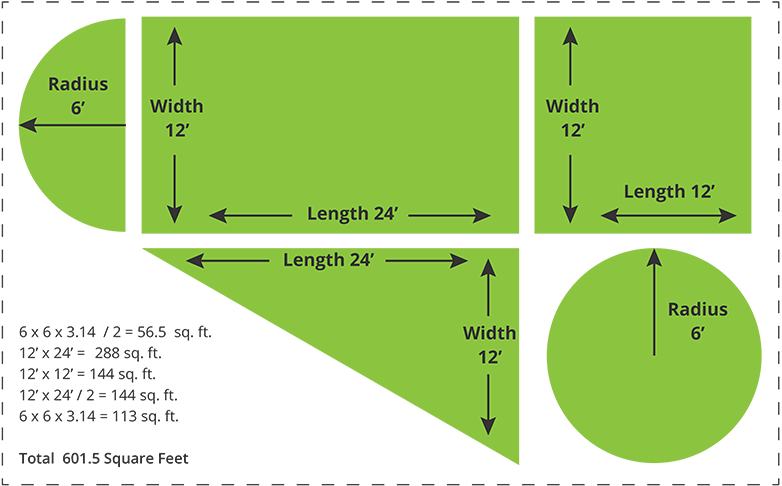
Image Source: gvt.net
Why Accurate Lawn Measurement Matters
Measuring your lawn isn’t just a chore; it’s a vital step for smart lawn care. When you know your lawn’s precise square footage of lawn, you avoid costly mistakes. Buying too much fertilizer or seed means wasted money. Buying too little means your lawn might not get the coverage it needs, leading to patchy growth or an incomplete project. For landscaping, knowing the dimensions helps you estimate material needs for patios, garden beds, or walkways. For those seeking professional lawn services, an accurate lawn area calculator or a DIY measurement provides a solid basis for quotes and avoids disputes.
Key Benefits of Precise Measurement:
- Cost Savings: Buy only what you need for seeds, fertilizer, soil, mulch, and other lawn products.
- Effective Treatment: Apply pesticides, herbicides, and fertilizers at the correct rates for optimal results and plant safety.
- Informed Landscaping: Accurately estimate materials for any garden or construction project.
- Accurate Quoting: Provide precise dimensions for lawn care services to get fair and accurate estimates.
- Efficient Planning: Better visualize and plan lawn renovations or additions.
Measuring Lawn Size: Basic Shapes First
Most lawns, at their core, can be broken down into simpler geometric shapes. Mastering the measurement of these basic shapes is the first step to measuring lawn size. We’ll start with rectangles, squares, and circles.
Measuring Rectangles and Squares
Rectangles and squares are the most common lawn shapes. Their measurement is straightforward using a basic lawn area formula.
The Formula:
Area = Length × Width
Steps:
- Identify the Length: This is the longest side of your rectangular or square lawn area.
- Identify the Width: This is the shorter side of your rectangular or square lawn area.
- Measure: Use your chosen lawn measurement tools (like a tape measure or a measuring wheel) to get the length and width in feet.
- Calculate: Multiply the length by the width. The result is the square footage of lawn for that section.
Example:
If your lawn section is 50 feet long and 30 feet wide:
Area = 50 ft × 30 ft = 1500 sq ft
Measuring Circles
Circular areas, like around a tree or a circular garden bed, also require a specific lawn area formula.
The Formula:
Area = π × radius² (where π is approximately 3.14)
Steps:
- Find the Diameter: Measure the widest part of the circle across the center.
- Calculate the Radius: The radius is half the diameter. Radius = Diameter / 2.
- Measure: Get the diameter measurement in feet.
- Calculate:
- Divide the diameter by 2 to find the radius.
- Square the radius (multiply it by itself).
- Multiply the squared radius by 3.14 (or use a calculator’s π button for more accuracy). The result is the square footage of lawn for that circular area.
Example:
If the diameter of a circular lawn area is 20 feet:
Radius = 20 ft / 2 = 10 ft
Area = 3.14 × (10 ft)² = 3.14 × 100 sq ft = 314 sq ft
Tools for Accurate Lawn Measurement
Having the right lawn measurement tools makes the process significantly easier and more accurate. Here are some popular and effective options for how to measure a yard.
Essential Measuring Tools:
-
Measuring Tape (Tape Measure):
- Pros: Readily available, inexpensive, and good for smaller or more precise measurements. Steel tape measures are durable.
- Cons: Can be difficult to manage for long distances, requiring multiple people or careful anchoring. Accuracy can decrease over uneven terrain.
- Tip: For longer distances, use a tape measure with a lockable mechanism and consider a friend to help hold the end.
-
Measuring Wheel (Rolling Measure):
- Pros: Excellent for covering long distances quickly and easily. It counts the distance as you roll it along the ground. Many have digital readouts.
- Cons: Can be less accurate on very bumpy terrain or if not rolled in a perfectly straight line.
- Tip: Keep the wheel firmly on the ground and maintain a consistent walking pace for best results.
-
Pacing:
- Pros: No tools required, can be done anywhere.
- Cons: Least accurate method; requires you to know your average stride length.
- How to Use:
- Walk a known distance (e.g., 100 feet) and count your steps.
- Divide the known distance by your step count to find your average stride length.
- Walk your lawn boundary, counting your steps.
- Multiply your step count by your average stride length to estimate the distance.
- Tip: This is best used as a rough estimate or a backup if other tools aren’t available.
-
GPS Apps and Devices:
- Pros: Modern technology allows for highly accurate measurements, especially for irregular shapes. Many smartphone apps are available.
- Cons: Accuracy can vary based on satellite signal strength and the app’s quality. May require a subscription for advanced features.
- Tip: Walk the perimeter of your lawn slowly and deliberately for the best GPS readings.
-
Laser Distance Measurers:
- Pros: Very accurate for straight-line measurements, especially for longer distances or areas where you can’t easily reach the end.
- Cons: Require a clear line of sight. Can be more expensive than tape measures.
- Tip: Ensure the device is held steady and pointed directly at the target.
Measuring Lawn Area: The Practical Steps
Now that you know the basic shapes and tools, let’s get into the practical steps for measuring lawn area. The goal is to break down your entire yard into measurable sections.
Step-by-Step Measurement Process:
-
Sketch Your Lawn:
- Start with a piece of paper or a digital drawing tool.
- Draw a rough outline of your entire property.
- Mark significant features like your house, driveway, sheds, patios, trees, and garden beds. These are often areas you don’t need to include in your lawn area.
-
Divide and Conquer:
- Look at your sketch. Can you see distinct rectangular or square sections?
- Mentally (or on your sketch) divide your lawn into these simpler shapes. For example, a backyard might be a large rectangle with a smaller rectangular section for a garden bed.
- If you have curved areas, you can approximate them with polygons (multiple straight sides) or use specific formulas for circles or segments.
-
Measure Each Section:
- Take your chosen lawn measurement tools (measuring wheel or tape measure are usually best for this stage) and physically walk the boundaries of each section.
- For rectangles and squares, measure the length and width of each.
- For curved areas like a circular flower bed, measure the diameter.
- Record these measurements clearly on your sketch for each section.
-
Calculate the Area of Each Section:
- Use the appropriate lawn area formula for each shape you’ve measured.
- Keep a clear record of the square footage of lawn for each individual section.
Calculating the Total Lawn Area:
- For Simple Shapes: If your entire lawn is one large rectangle or square, you’re done after step 4!
- For Combined Shapes: If you divided your lawn into multiple sections, add up the square footage of lawn from each section.
- Total Lawn Area = Area (Section 1) + Area (Section 2) + Area (Section 3) + …
Example of Combining Areas:
Imagine your backyard is a large rectangle with a smaller rectangular patio area that you don’t want to include in your lawn calculation.
- Backyard Rectangle: 60 ft (length) × 40 ft (width) = 2400 sq ft
- Patio Rectangle: 20 ft (length) × 15 ft (width) = 300 sq ft
To find the lawn area:
Lawn Area = Backyard Area – Patio Area
Lawn Area = 2400 sq ft – 300 sq ft = 2100 sq ft
Measuring Irregular Lawn Shapes
Measuring irregular lawn shapes is where DIY lawn measurement gets a little more creative. Most lawns have some degree of irregularity due to natural contours, existing landscaping, or property lines.
Strategies for Irregular Shapes:
-
Triangulation:
- Divide the irregular area into as many triangles as possible.
- The Formula for a Triangle: Area = ½ × base × height. To use this, you’ll need to measure the base and then the perpendicular height from the base to the opposite vertex.
- If you have the lengths of all three sides of a triangle (a, b, c), you can use Heron’s formula:
- First, calculate the semi-perimeter (s): s = (a + b + c) / 2
- Then, Area = √[s(s-a)(s-b)(s-c)]
- How to Measure: Measure the lengths of the sides of each triangle. For the height, you might need a helper to hold a tape measure perpendicular to the base while you measure from a point.
- Accuracy: This method can be very accurate if done carefully, but it requires patience and precision in measurement.
-
Approximation with Rectangles and Triangles:
- Break down the irregular shape into a combination of rectangles, squares, and triangles.
- For curved sections, you can approximate them with a series of short, straight lines, forming many small triangles or trapezoids. The more segments you use, the more accurate your approximation will be.
-
Using Online Tools: Many websites and apps offer a lawn area calculator. You can often input coordinates or draw your lawn’s shape on a map, and the tool will calculate the square footage of lawn for you. This is a convenient way to handle complex shapes.
Converting Lawn Measurements
Sometimes you might have measurements in different units, or you might need to convert your final area measurement. Common units for lawn care are square feet (sq ft) and acres.
- Feet to Yards: 1 yard = 3 feet
- Square Feet to Square Yards: 1 square yard = 9 square feet
- To convert sq ft to sq yards, divide by 9.
- Square Feet to Acres: 1 acre = 43,560 square feet
- To convert sq ft to acres, divide by 43,560.
Example Conversion:
You’ve calculated your lawn area to be 10,000 sq ft.
- To Square Yards: 10,000 sq ft / 9 sq ft/sq yd = 1111.11 sq yd
- To Acres: 10,000 sq ft / 43,560 sq ft/acre = 0.23 acres
This ability to convert lawn measurements is vital when comparing product coverage rates or understanding contractor quotes that might be in acres.
Measuring Specific Lawn Features
Beyond the overall lawn area, you might need to measure specific features for targeted treatments or improvements.
Measuring Flower Beds or Garden Plots:
- Rectangular/Square: Use the standard length x width formula.
- Circular: Use the π × radius² formula.
- Irregular: Break into smaller, measurable shapes or use triangulation.
Measuring Driveways or Patios (for material estimation):
- Rectangular: Length x width.
- Irregular Shapes: Often easiest to break into segments or use online mapping tools. You’ll need the square footage of lawn (or hardscape) to estimate materials like concrete, pavers, or gravel.
Calculating Lawn Perimeter:
Sometimes, knowing the calculate lawn perimeter is important, especially for tasks like installing edging or fencing.
The Process:
- Sketch your lawn and divide it into sections if necessary.
- Measure the length of each side of each section.
- Add up all the side lengths to get the total perimeter.
Example:
A rectangular lawn that is 50 feet long and 30 feet wide.
Perimeter = 2 × (Length + Width)
Perimeter = 2 × (50 ft + 30 ft)
Perimeter = 2 × 80 ft
Perimeter = 160 ft
For irregular shapes, simply measure each distinct boundary segment and add them all together. This ensures you know exactly how much edging or fencing material you’ll need.
Using a Lawn Area Calculator
For those who prefer digital assistance, a lawn area calculator can be a fantastic tool. These online calculators simplify the process, especially for complex or irregular yards.
How They Work:
- Map-Based Calculators: You often use a satellite or aerial view of your property. You then “draw” the outline of your lawn area directly onto the map. The calculator automatically computes the square footage of lawn.
- Shape-Based Calculators: You select basic shapes (rectangle, circle, triangle) and input your measurements. The calculator does the math for you and can sum up multiple shapes.
- Coordinate-Based Calculators: For highly technical users, some calculators allow inputting GPS coordinates to define boundaries.
Tips for Using Online Calculators:
- Accuracy of Input: Ensure you are drawing or inputting the correct boundaries. Zoom in on the map to be precise.
- Exclude Non-Lawn Areas: Remember to draw around your house, driveway, patios, and other structures that are not part of your lawn.
- Double-Check: If possible, use a second method (like a tape measure) to verify the calculated area, especially if the stakes are high.
Frequently Asked Questions About Lawn Measurement
Q1: What is the easiest way to measure my lawn?
A1: For simple rectangular or square lawns, a measuring wheel or a tape measure is the easiest. For more complex shapes, using a GPS-enabled smartphone app or an online map-based lawn area calculator can be the simplest and most accurate method.
Q2: How accurate do my lawn measurements need to be?
A2: Accuracy is important for efficient use of lawn products and for getting fair quotes. Aim for measurements that are accurate to within a foot or two for overall dimensions, especially when dealing with longer lengths and widths. For smaller areas like garden beds, more precision might be needed.
Q3: Can I use Google Maps to measure my lawn?
A3: Yes, Google Maps has a “Measure distance” tool that can be used to estimate the size of your lawn. While not as precise as dedicated lawn measurement tools, it’s a good way to get a rough idea. You can draw lines along your property boundaries and sum the lengths, or in some interfaces, you can create a polygon to estimate area.
Q4: How do I measure a sloped lawn?
A4: For sloped areas, measure along the surface of the ground. A measuring wheel is often better than a tape measure here, as it follows the contour of the slope. For calculations, you’re typically interested in the surface area you’ll be working on, so measuring along the slope is correct.
Q5: What if my lawn has many trees and obstacles?
A5: Carefully measure around each obstacle. Divide your lawn into sections, treating the area around each tree or obstacle as a separate shape if it interrupts the main rectangular or square areas. You might have to approximate the area around a tree as a circle or irregular shape. The goal is to subtract these non-lawn areas from larger sections if necessary.
Q6: How do I calculate the amount of seed or fertilizer needed?
A6: Check the product packaging. It will usually state how much area (e.g., in square feet) a bag or box covers. Divide your total lawn square footage of lawn by the coverage rate of the product to determine how much you need to buy. For example, if a bag covers 5,000 sq ft and your lawn is 10,000 sq ft, you’ll need two bags.
By following these steps and using the right tools, you can confidently measure your lawn, making all your lawn care and landscaping projects more successful and cost-effective. Happy measuring!