
Can you measure a lawn with a tape measure? Yes, a tape measure is a primary tool for accurately measuring a lawn.
Knowing the exact size of your lawn is essential for many outdoor projects. Whether you’re planning a landscaping overhaul, purchasing sod, calculating fertilizer needs, or even just figuring out how much grass seed to buy, precise measurements are key. Getting your lawn area calculation right means you won’t overspend on materials or end up with too much or too little. This guide will walk you through simple lawn measurement techniques to accurately determine your backyard square footage and measuring grass area, ensuring your projects run smoothly.
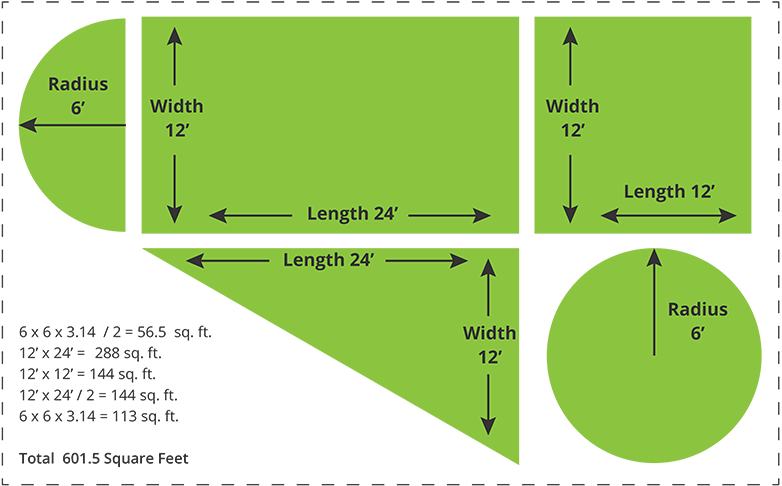
Image Source: gvt.net
Why Accurate Lawn Measurements Matter
Before diving into the “how,” let’s quickly touch upon the “why.” Accurate measurements impact several aspects of lawn care and landscaping:
- Sod Installation: When you’re laying sod, you need to know the exact square footage to order the correct amount. Too little, and you’ll have gaps; too much, and you’ll have waste.
- Seeding and Fertilizing: Products for seeding and fertilizing are typically packaged with coverage rates per square foot. Having an accurate lawn area calculation prevents under- or over-application, saving money and ensuring optimal plant health.
- Irrigation Systems: Designing or adjusting sprinklers requires knowing the area they need to cover.
- Landscaping Projects: Whether it’s adding a patio, planting a flower bed, or installing a fence, precise measurements are foundational for proper planning and costing.
- Lawn Mowing Coverage: While not strictly for purchasing, knowing your lawn mowing coverage can help you estimate mowing time and optimize your routes.
- Pest and Weed Control: Targeted applications of treatments are more effective and environmentally friendly when you know the exact area you’re treating.
Tools You’ll Need for Measuring Your Lawn
Gathering the right tools makes the measuring process much easier and more accurate.
- Measuring Tape: A long tape measure (50-100 feet or more) is crucial. A metal tape measure is often more durable and easier to read than a fabric one.
- Measuring Wheel (Optional but Recommended): For larger or irregularly shaped lawns, a measuring wheel (also called a measuring roller or surveyor’s wheel) can significantly speed up the process and improve accuracy.
- Stakes or Markers: Small flags, stakes, or even spray paint can help mark corners and boundaries, especially for irregular shapes.
- Paper and Pen/Pencil: To sketch your lawn and record measurements.
- Calculator: For performing the necessary lawn area calculation.
- Smartphone with Measuring App (Optional): Some apps can use your phone’s GPS or camera to estimate area, though these are often less precise than physical measurements.
Basic Lawn Measurement Techniques for Simple Shapes
Most lawns, at their core, can be broken down into basic geometric shapes like rectangles, squares, and triangles.
Measuring a Rectangular or Square Lawn
This is the simplest scenario.
Steps:
- Identify the Boundaries: Determine the clear edges of your lawn. This might be a fence, a sidewalk, a property line, or the edge of a flower bed.
- Measure the Length: Start at one corner and extend your tape measure along one side (the length). Keep the tape measure straight and taut. Record this measurement.
- Measure the Width: From the same starting corner, measure along the adjacent side (the width). Again, keep the tape measure straight. Record this measurement.
-
Calculate the Area: To find the turf area calculation, multiply the length by the width.
- Formula: Area = Length × Width
- Example: If your lawn is 50 feet long and 30 feet wide, the area is 50 ft × 30 ft = 1500 sq ft.
Measuring a Triangular Lawn
Many yards have triangular sections, perhaps where two fences meet at an angle.
Steps:
- Identify the Base and Height: Choose one side of the triangle as the “base.” Then, find the perpendicular distance from the opposite corner (the apex) to the base. This is the “height.”
- Measure the Base: Measure the length of the chosen base. Record it.
- Measure the Height: Measure the perpendicular distance from the apex to the base. This often requires using a second person to hold one end of the tape measure at the apex while another person walks out from the base to find the longest (perpendicular) distance. Alternatively, you can use a carpenter’s square to find a right angle. Record this measurement.
-
Calculate the Area: The formula for a triangle’s area is half the base times the height.
- Formula: Area = ½ × Base × Height
- Example: If the base is 20 feet and the height is 15 feet, the area is ½ × 20 ft × 15 ft = 150 sq ft.
Measuring More Complex Lawn Shapes: Breaking it Down
Most lawns aren’t perfect rectangles or triangles. The key to accurately measuring these is to break them down into smaller, manageable shapes. This is the core of landscape measurement.
The “Rectangularization” Method
For L-shaped or U-shaped lawns, you can divide them into several rectangles.
Steps:
- Sketch Your Lawn: Draw a rough outline of your lawn on paper.
- Divide into Rectangles: Mentally (or by drawing on your sketch) divide the lawn into several distinct rectangular sections. Try to make the divisions as simple as possible.
- Measure Each Rectangle: Measure the length and width of each individual rectangle.
- Calculate Each Rectangle’s Area: Use the formula Area = Length × Width for each section.
- Sum the Areas: Add up the areas of all the individual rectangles to get your total lawn area calculation.
Example: An L-Shaped Lawn
Imagine an L-shaped lawn. You can divide it into two rectangles.
- Rectangle 1: Measure its length and width. Let’s say it’s 40 ft x 20 ft. Area 1 = 40 * 20 = 800 sq ft.
- Rectangle 2: The remaining part of the “L.” You’ll need to be careful here. If the total length of the long side was 60 ft, and Rectangle 1 took up 40 ft, the remaining length for the second part of that side would be 20 ft. If the total width of the shorter side was 30 ft, and Rectangle 1 took up 20 ft of that width, the remaining width for Rectangle 2 would be 10 ft. So, Rectangle 2 might be 20 ft x 10 ft. Area 2 = 20 * 10 = 200 sq ft.
- Total Area: 800 sq ft + 200 sq ft = 1000 sq ft.
Table: L-Shaped Lawn Measurement Breakdown
| Section | Length (ft) | Width (ft) | Area (sq ft) |
|---|---|---|---|
| Rectangle 1 | 40 | 20 | 800 |
| Rectangle 2 | 20 | 10 | 200 |
| Total | 1000 |
The “Triangle and Rectangle” Method
Many irregular shapes can be made by combining rectangles and triangles.
Steps:
- Sketch and Divide: Draw your lawn shape and divide it into rectangles and triangles.
- Measure Each Piece: Measure the dimensions for each rectangle (length and width) and each triangle (base and height).
- Calculate Areas: Compute the area for each rectangle and triangle separately.
- Sum All Areas: Add the areas of all the shapes together for your final estimating lawn size.
Example: A Lawn with a Sloped End
Consider a lawn that is mostly rectangular but has a section that tapers to a point, forming a triangle at one end.
- Rectangle: Measure the main rectangular portion. Let’s say it’s 60 ft x 30 ft. Area = 60 * 30 = 1800 sq ft.
- Triangle: Measure the base of the triangular section (which would be the width of the main rectangle, 30 ft) and its height (the additional length this section extends). Let’s say the height is 15 ft. Area = ½ * 30 ft * 15 ft = 225 sq ft.
- Total Area: 1800 sq ft + 225 sq ft = 2025 sq ft.
Using a Measuring Wheel for Larger Areas
If your property is large, or your lawn has many curved edges, a measuring wheel is invaluable for measuring grass area.
Steps:
- Start at a Point: Begin at a corner or a designated starting point.
- Roll the Wheel: Walk along the edge of the lawn, keeping the wheel as straight as possible. The wheel will count the distance as you go.
- Mark and Record: Stop at each corner or change in direction and record the distance measured so far. Resetting the counter at each segment can make calculations easier if you’re dividing into shapes.
- For Straight Lines: If you’re measuring a straight property line, you can simply roll the wheel from one end to the other and record the total distance.
- For Curves: For curved boundaries, you’ll need to approximate. Roll the wheel along the curve as closely as possible, making slight adjustments. For more accuracy on curves, you can try to break the curve into a series of short, straight lines and measure each segment.
Dealing with Curved and Irregular Boundaries
Curved edges are the trickiest part of lawn measurement techniques.
The “Chord” Method for Curves
You can approximate curves by treating them as a series of short, straight lines (chords).
Steps:
- Sketch the Curve: Draw the curved section of your lawn.
- Add Stakes: Place stakes at intervals along the curve. The closer the stakes, the more accurate your measurement will be.
- Measure Straight Lines: Measure the straight-line distance between each pair of stakes.
- Measure Perpendicular Distances (Optional for advanced): For a more accurate area calculation of a curved segment (like a segment of a circle), you might need to measure the distance from the midpoint of each chord to the curve itself, or use more advanced geometric formulas. However, for most landscaping needs, treating curves as a series of straight lines is sufficient for estimating lawn size.
- Combine with Other Shapes: Measure any straight sections of your lawn and then add the areas of the small geometric shapes you’ve created along the curve.
Using a Measuring Wheel on Curves
A measuring wheel is generally better for curves than a tape measure. Simply roll the wheel along the edge, keeping it as close to the boundary as possible. You’ll still need to break the curve down mentally or with stakes if you’re trying to calculate specific geometric shapes within the curve. For a full perimeter measurement, the wheel is more efficient.
Calculating the Perimeter of Your Lawn
While area is crucial for coverage, calculating lawn perimeter is important for tasks like installing edging, fencing, or sprinkler systems along the edge.
Steps:
- Measure Each Side: Walk the boundary of your lawn and measure the length of each distinct straight edge.
- Measure Curved Sections: For curved sections, measure them in segments using your tape measure or by rolling your measuring wheel along the curve.
- Add All Measurements: Sum up the lengths of all the individual sides and curved segments to get the total perimeter.
Example:
- Rectangle: 50 ft + 30 ft + 50 ft + 30 ft = 160 ft.
- L-shaped lawn (using the previous example): 40 ft + 20 ft + 20 ft (new side) + 10 ft (new side) + 60 ft (original long side) + 30 ft (original wide side) = 180 ft.
Table: Lawn Perimeter Example
| Section | Measurement (ft) |
|---|---|
| Side 1 | 50 |
| Side 2 | 30 |
| Side 3 | 50 |
| Side 4 | 30 |
| Total | 160 |
Estimating Lawn Size for Different Scenarios
Let’s look at how accurate measurements help in common gardening and landscaping tasks.
Estimating Lawn Size for Sod Installation
When buying sod, you’ll typically purchase it by the square foot or square yard.
- Calculate Total Area: First, get your precise lawn area calculation in square feet.
- Convert to Square Yards (if needed): There are 9 square feet in 1 square yard. To convert, divide your total square footage by 9.
- Formula: Square Yards = Square Feet / 9
- Add a Buffer: It’s often wise to order 5-10% extra sod to account for cuts, waste, and potential mistakes. Multiply your total square footage by 1.05 or 1.10.
Estimating Lawn Size for Seeding and Fertilizing
Coverage rates on seed and fertilizer bags are usually per 1000 square feet.
- Calculate Total Area: Ensure your measuring grass area is accurate in square feet.
- Determine Application Rate: Check the product packaging for the recommended application rate (e.g., 4 lbs of seed per 1000 sq ft).
- Calculate Total Product Needed:
- Formula: Total Product = (Total Lawn Area / 1000) × Application Rate per 1000 sq ft
- Example: For a 1500 sq ft lawn needing 4 lbs of seed per 1000 sq ft: (1500 / 1000) * 4 lbs = 1.5 * 4 = 6 lbs of seed.
Estimating Lawn Size for Mulching or Ground Cover
Similar to seeding, mulching and ground cover products have coverage rates.
- Calculate Area: Get your garden size estimation or lawn area calculation.
- Determine Depth: Decide on the desired depth of mulch or ground cover (e.g., 3 inches).
- Calculate Volume: Convert depth to feet (e.g., 3 inches = 0.25 feet).
- Formula: Volume (cubic feet) = Area (sq ft) × Depth (ft)
- Convert to Product Units: Mulch is often sold in cubic yards. 1 cubic yard = 27 cubic feet.
- Formula: Cubic Yards = Volume (cubic feet) / 27
Advanced Techniques and Tools
For very large properties or complex terrains, more advanced methods might be employed.
Using GPS and GIS Technology
- GPS Devices: Handheld GPS units or GPS apps on smartphones can track your path along the lawn’s perimeter, providing a calculated area. Accuracy can vary based on satellite signal strength.
- GIS Software: For professionals, Geographic Information System (GIS) software can be used with aerial imagery or survey data to map and calculate areas with high precision.
Aerial Measurements
- Satellite Imagery: Services like Google Earth allow you to use their measurement tools to draw polygons around your lawn and get an area estimate. This is convenient but can be less accurate for precisely defined lawn edges due to image resolution and potential distortions.
Tips for Accurate Lawn Measurement
- Measure on a Clear Day: Avoid measuring when it’s raining or windy, as this can make it difficult to keep tape measures straight and read them accurately.
- Walk the Entire Perimeter: Ensure you’re measuring the actual boundary of the grass, not just the property line if there are un-mowed areas.
- Be Consistent with Units: Stick to feet and square feet, or yards and square yards, throughout your calculations to avoid errors.
- Double-Check Your Work: Review your sketches and calculations. If possible, have a second person check your measurements.
- Consider Obstacles: Account for areas like patios, driveways, sheds, or large trees that are not part of the grass area when you are measuring grass area. Exclude these from your final lawn area calculation.
- Take Photos: Snap photos of your lawn with the measurements written down or marked on them. This serves as a good record.
Frequently Asked Questions (FAQ)
Q1: How do I measure a circular lawn?
A1: To measure a circular lawn, find the radius (the distance from the center to the edge). The formula for the area of a circle is πr², where π (pi) is approximately 3.14. Measure the diameter (the distance across the circle through the center) and divide by two to get the radius.
Q2: What if my lawn has many trees and flower beds?
A2: You’ll need to break down your lawn into smaller sections. Measure the main rectangular or square parts, and then measure the irregular shapes around trees and beds. You can often treat the areas around trees as circles or segments of circles, and flower beds as rectangles or other polygons. Subtract these non-grass areas from the total property area to get your measuring grass area.
Q3: How do I convert my lawn measurements from square feet to square yards?
A3: To convert square feet to square yards, divide the total square footage by 9.
Q4: Is there a difference between measuring the lawn area and measuring the property area?
A4: Yes. When you measure the lawn area, you are specifically measuring the area covered by grass. Property area is the total land parcel. For landscaping, you are almost always interested in the lawn area calculation.
Q5: What is the best way to estimate lawn size for a very large property?
A5: For very large properties, using a measuring wheel or GPS device is highly recommended. Breaking down the property into large, manageable sections (like quarter-acre plots if applicable) and measuring each one can also simplify the process.
By following these simple guides and lawn measurement techniques, you can confidently determine your lawn’s size, paving the way for successful landscaping projects, efficient sod application, and healthier turf. Accurate measurements are the foundation of any good lawn care plan, ensuring your efforts are focused and effective.