
So, how do you quote lawn mowing effectively to ensure you make more money? The key is to accurately assess the scope of work for each property and apply a pricing structure that reflects the value you provide, considering factors like lot size, terrain, complexity, and your business overhead.
Running a lawn mowing business can be very rewarding. You get to work outdoors, build relationships with clients, and be your own boss. But to be successful and profitable, you need to know how to price your services right. This isn’t just about picking a number out of thin air. It’s a strategic process that ensures you cover your costs, pay yourself fairly, and still remain competitive. Let’s dive deep into how to quote lawn mowing to maximize your earnings.
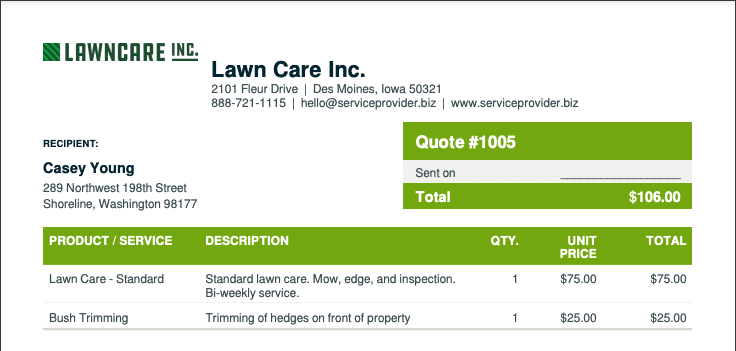
Image Source: www.getjobber.com
Figuring Out Your Lawn Mowing Price
Getting your lawn mowing price right is the foundation of a profitable business. It’s not just about covering the cost of gas and blade sharpening; it’s about valuing your time, expertise, and the quality of service you deliver.
Factors That Influence Your Pricing
Several elements contribute to the final lawn mowing price. Think of these as the building blocks for every estimate you create.
Lot Size and Shape
This is the most obvious factor. A larger yard naturally takes more time and effort to mow. But it’s not just about the square footage.
- Rectangular vs. Irregular Lots: A simple rectangular lot is easier to mow efficiently than a lot with many curves, obstacles, or oddly shaped sections.
- Mowing Patterns: Efficient mowing patterns can save time. Knowing how to best navigate a yard without excessive overlapping or missed strips is crucial.
Terrain and Slope
The ground itself can significantly impact your time and effort.
- Flat vs. Hilly Terrain: Mowing a steep hill is much more physically demanding and time-consuming than mowing a flat surface. You might even need specialized equipment for very steep slopes.
- Obstacles: Trees, flower beds, bushes, patios, and other landscaping features all slow down the mowing process. You’ll need to maneuver around them carefully, which takes extra time and precision.
Grass Type and Condition
Not all grass is created equal, and its condition matters too.
- Thick, Tall Grass: If grass is overgrown, it will be harder to cut and may require multiple passes or a more powerful mower. This adds to the time spent.
- Weed-Infested Lawns: Weeds can make mowing more difficult, clog your mower, and require extra cleanup.
- Grass Clippings Management: Will you bag clippings, mulch them, or side-discharge? Bagging adds time and requires disposal, impacting your grass cutting cost.
Equipment Used
The type of mower you use affects efficiency and your overhead.
- Riding Mowers vs. Push Mowers: Larger areas are best tackled with riding mowers, which are faster. Smaller, intricate yards might still require a push mower for precision.
- Edgers and Trimmers: These are essential for a clean finish and add to the overall service time and cost.
Frequency of Service
How often you mow impacts the density and height of the grass.
- Weekly vs. Bi-Weekly: Weekly mowing generally means less grass to cut each time, making it quicker. Bi-weekly or monthly services might encounter taller, denser grass.
Travel Time and Distance
Your travel time to and from the client’s property is a hidden cost.
- Fuel and Vehicle Wear: Driving to each job consumes fuel and adds wear and tear to your vehicle.
- Efficiency of Routes: Grouping clients in the same general area can save significant travel time and cost.
Creating Your Pricing Structure
Once you’ve identified the factors, you need a system to translate them into a price.
Option 1: Per-Mow Pricing
This is a common approach where you set a price per mow.
- Base Price: Establish a minimum price for a standard-sized, easy-to-mow lawn. This covers your basic costs and a small profit.
- Add-ons: For larger sizes, slopes, or obstacles, add incremental charges. For example, an extra $5 for every 1,000 sq ft over a certain threshold, or an extra $10 for significant slopes.
- Example:
- Small Yard (up to 5,000 sq ft, flat): $40
- Medium Yard (5,001 – 10,000 sq ft, flat): $55
- Large Yard (10,001 – 15,000 sq ft, flat): $70
- Add $10 for moderate slope.
- Add $20 for steep slope or significant obstacles.
Option 2: Hourly Rate
This can be useful for complex jobs or when you’re unsure of the time.
- Set an Hourly Rate: Calculate your desired hourly wage, factoring in all business expenses. A common range for lawn mowing rates can be anywhere from $40 to $75 per hour, depending on your location and services.
- Estimate Time: Based on your experience, estimate how long the job will take and multiply by your hourly rate. Always add a buffer for unexpected issues.
- Pros: Guarantees you’re paid for all time spent.
- Cons: Clients might be hesitant due to potential uncertainty in cost.
Option 3: Package Deals
Offer recurring services at a discounted rate.
- Weekly/Bi-Weekly Packages: Offer a slightly lower price per mow if clients sign up for regular service. This builds predictable revenue and customer loyalty.
- Seasonal Contracts: Bundle mowing with other services like fertilization or aeration for a yearly contract.
Crafting a Comprehensive Lawn Care Estimate
A good lawn care estimate is more than just a number; it’s a clear communication tool that builds trust with your clients. It should be detailed, professional, and leave no room for confusion.
What to Include in Your Estimate
Every estimate you provide should cover key information.
Client Information
- Client Name
- Address
- Contact Number and Email
Service Details
- Specific Services: Clearly list what you will do. For example:
- Mow entire lawn area (specify square footage if possible).
- Edge all sidewalks, driveways, and garden beds.
- Trim around obstacles (trees, fences).
- Blow clippings off hard surfaces (patios, walkways).
- Bagging and disposal of clippings (if applicable).
- Frequency: Weekly, bi-weekly, monthly, or one-time service.
Pricing Breakdown
- Base Price: The cost for the primary mowing service.
- Additional Services: Itemize costs for edging, trimming, blowing, or other tasks.
- Surcharges: Clearly state any charges for slopes, difficult terrain, or extensive obstacles.
- Total Estimated Cost: The final price for the quoted services.
Terms and Conditions
- Payment Terms: When is payment due? (e.g., upon completion, net 15 days).
- Cancellation Policy: What happens if a client cancels or reschedules?
- Validity Period: How long is the estimate valid for?
- Guarantee: Do you offer any satisfaction guarantee?
Presenting Your Estimate
How you present the estimate matters.
- Professional Format: Use a branded letterhead or digital template.
- Clarity and Conciseness: Avoid jargon. Use simple language that the client can easily understand.
- Timeliness: Deliver estimates promptly after assessing the property.
Deciphering Commercial Lawn Maintenance Quotes
Commercial lawn maintenance quotes often differ from residential ones due to scale, client expectations, and contract terms.
Key Differences for Commercial Properties
- Larger Acreage: Commercial properties can be vast, requiring heavy-duty equipment and a team approach.
- Higher Expectations: Businesses often expect a more polished, manicured look. They may have specific landscaping standards.
- Detailed Specifications: Contracts might include detailed specifications for mowing patterns, trimming heights, and even specific times of day for service to minimize disruption to business operations.
- Liability Insurance: Commercial clients will often require proof of significant liability insurance.
- Contract Length: Services are typically contracted for longer periods (e.g., 6 months, 1 year, or multi-year agreements).
Creating Commercial Quotes
- Site Assessment is Crucial: Spend ample time walking the entire property. Note all areas to be mowed, including slopes, ditches, and any specialized landscaping.
- Factor in All Services: Commercial contracts often include more than just mowing:
- Trimming and edging around all buildings, parking lots, and landscape beds.
- Blowing all hard surfaces clean.
- Pruning of shrubs and trees.
- Weed control and fertilization.
- Seasonal cleanups (leaf removal, debris clearing).
- Equipment Needs: Will you need a large zero-turn mower, specialized trimming equipment, or even a flail mower for overgrown areas?
- Labor Costs: Estimate the number of crew members and hours required for efficient completion.
- Overhead and Profit Margin: Ensure your pricing covers insurance, equipment depreciation, fuel, labor, administrative costs, and a healthy profit margin.
- Bidding Strategy: You might bid slightly lower on the first year of a multi-year contract to secure the business, with planned increases in subsequent years.
Mastering Yard Work Pricing
Yard work pricing encompasses more than just mowing. It’s about offering a full suite of services that clients need to maintain their outdoor spaces.
Expanding Your Service Offerings
To make more money, think beyond basic mowing.
Basic Mowing Package
- Mowing
- Edging
- Trimming
- Blowing hard surfaces
Premium Packages
- Full-Service Lawn Care: Includes mowing package plus fertilization, aeration, overseeding, and weed control.
- Seasonal Cleanup: Leaf removal in fall, spring debris cleanup.
- Mulching and Planting: Adding mulch to beds, planting flowers or shrubs.
- Hedge Trimming and Pruning: Maintaining shrubs and small trees.
Pricing for Additional Services
- Per-Service Pricing: Charge a separate fee for each additional service.
- Edging: Can be $0.50 – $1.00 per linear foot, or included in a mowing package.
- Trimming: Often included in mowing, but if extensive, can be an add-on.
- Blowing: Usually included in mowing.
- Fertilization: Typically priced per 1,000 sq ft, with costs varying based on the fertilizer used and number of applications.
- Mulching: Charged per cubic yard of mulch, plus labor.
- Hedge Trimming: Can be priced hourly or by the linear foot.
- Bundle Pricing: Offer discounts when clients combine multiple services. This encourages them to use you for more of their yard needs.
Example of Pricing for Additional Services:
| Service | Pricing Unit | Example Price Range | Notes |
|---|---|---|---|
| Mowing | Per mow | $40 – $150+ | Based on size, complexity, frequency |
| Edging | Per linear foot | $0.50 – $1.00 | Along sidewalks, driveways, beds |
| Trimming | Per hour | $40 – $60 | For detailed work around obstacles |
| Blowing | Included | $0 | Hard surfaces after mowing/trimming |
| Fertilization | Per 1,000 sq ft | $40 – $70 | Depending on fertilizer type & app count |
| Mulching | Per cubic yard | $60 – $120 | Includes mulch cost + labor |
| Hedge Trimming | Per linear foot | $3 – $8 | For hedges up to 6ft height |
| Leaf Removal | Per cubic yard | $50 – $100 | Or contracted seasonally |
Gauging Residential Lawn Service Pricing
Residential lawn service pricing is all about understanding the typical homeowner’s budget and expectations for their property’s appearance.
Factors Specific to Residential Clients
- Aesthetics: Homeowners often prioritize curb appeal. This means clean lines, sharp edges, and a well-manicured look are important.
- Neighborhood Norms: What are competitors charging in the area for similar services? You need to be competitive, but not so cheap that you undervalue your work.
- Homeowner Association (HOA) Rules: Some HOAs have specific requirements for lawn maintenance, which you’ll need to adhere to.
- Accessibility: Driveway access, gate codes, and dog policies all need to be considered for efficient service.
How to Determine Your Residential Rates
- Calculate Your Costs:
- Direct Costs: Fuel, oil, mower blades, trimmer line, equipment maintenance.
- Indirect Costs: Insurance, vehicle payments/maintenance, marketing, administrative costs, software.
- Labor: Your own time and any employees’ wages.
- Desired Profit: What profit margin do you want to achieve?
- Analyze the Competition: Get quotes from other lawn care companies in your area. Don’t just look at the price; consider the quality of service offered.
- Time Your Services: Actually mow several different types of yards and time yourself accurately. This gives you real-world data.
- Mowing a standard 1/4 acre lot with some obstacles might take 45 minutes.
- Edging and trimming can add another 20-30 minutes.
- Blowing adds 10-15 minutes.
- Develop Your Pricing Tiers: Based on the above, create a pricing structure.
Example Residential Pricing Structure:
| Service Tier | Description | Estimated Time | Example Price |
|---|---|---|---|
| Basic Mow | Mow lawn, trim around obstacles, edge hard surfaces, blow clippings off walkways. | 45-75 min | $50 |
| Standard Mow + Trim | Basic Mow plus precise trimming around all landscape beds and tree bases for a cleaner finish. | 60-90 min | $65 |
| Premium Lawn Care | Standard Mow + Trim, plus basic weeding in landscape beds and blowing clippings from landscape beds. | 75-105 min | $85 |
| Add-ons: | |||
| – Bagging Clippings | $10 – $20 additional (depending on yard size) | ||
| – Steep Slope Fee | $15 – $30 additional (based on severity) | ||
| – Extensive Obstacles | $10 – $25 additional (multiple trees, complex garden beds, tight spaces) |
Calculating Lawn Mowing Rates
Your lawn mowing rates are the direct monetary value you place on your time and services. Getting these right is critical for profitability.
Formula for Setting Your Rates
A simple formula can help:
Hourly Rate = (Total Annual Operating Costs + Desired Annual Salary + Desired Annual Profit) / Total Billable Hours Per Year
Let’s break this down:
- Total Annual Operating Costs:
- Fuel, oil, maintenance, repairs
- Insurance (general liability, vehicle, workers’ comp if applicable)
- Equipment purchase/depreciation
- Vehicle purchase/depreciation, maintenance, insurance
- Marketing and advertising
- Software, phone, internet
- Office supplies, accounting fees
- Wages for employees (if any)
- Desired Annual Salary: What you want to earn for your own living.
- Desired Annual Profit: What you want to reinvest in the business or take as additional income.
- Total Billable Hours Per Year: This is crucial. Not all hours you work are billable. You need to account for:
- Travel time
- Estimates and sales
- Administrative work
- Equipment maintenance and downtime
- Unpaid holidays and vacation
- Bad weather days
Typical billable hours might be only 50-70% of total working hours.
Example Calculation:
- Total Annual Operating Costs: $30,000
- Desired Annual Salary: $50,000
- Desired Annual Profit: $20,000
- Total: $100,000
Assume you work 50 weeks a year, 40 hours per week = 2,000 total working hours.
If you estimate 60% billable hours: 2,000 hours * 0.60 = 1,200 billable hours.
Hourly Rate = $100,000 / 1,200 hours = $83.33 per hour.
This means your base rate for any task should reflect this hourly cost. You then apply this rate to the estimated time for each job.
Adjusting Your Rates for Different Services
While you might have a target hourly rate, you’ll convert this into per-service prices.
- Basic Mow: Estimate time (e.g., 1 hour) and multiply by your hourly rate. Add a buffer.
- Additional Services: Price these based on the estimated time and complexity.
Making Landscaping Service Estimates Accurate
Landscaping service estimates are often more complex than simple mowing, as they can involve design, material costs, and specialized labor.
Components of a Landscaping Estimate
- Design and Planning: If you’re offering design services, this needs to be priced separately.
- Material Costs: Plants, soil, mulch, gravel, pavers, edging, fertilizer, weed killer, etc. Get quotes from suppliers.
- Labor Costs:
- Crew hours for installation.
- Hours for operating machinery (e.g., mini-excavator, tiller).
- Your own time for project management and oversight.
- Equipment Rental: If specialized equipment is needed, factor in rental costs.
- Permits and Fees: Some projects may require permits.
- Contingency: Always add a contingency (5-15%) for unforeseen issues like unexpected soil conditions or material price increases.
The Estimating Process for Landscaping
- Initial Consultation: Meet with the client, discuss their vision, budget, and needs.
- Site Analysis: Measure the area, assess soil conditions, sun exposure, drainage, and existing features.
- Design Development (if applicable): Create a plan or sketch.
- Material Take-off: List all materials needed and get quotes.
- Labor Estimation: Break down the project into phases and estimate the labor hours for each.
- Calculate Total Cost: Sum up all material, labor, equipment, and permit costs.
- Add Markup/Profit: Apply your desired profit margin.
- Prepare Formal Estimate: Present a clear, itemized estimate to the client.
Optimizing Your Lawn Care Business Pricing
Lawn care business pricing is an ongoing process. You need to review and adjust your prices regularly to stay profitable and competitive.
Strategies for Profitability
- Track Your Time and Expenses Religiously: Use software or spreadsheets to monitor exactly how long each job takes and what it costs. This data is invaluable for refining your pricing.
- Know Your Numbers: Understand your break-even point for different services.
- Bundle Services: Encourage clients to purchase multiple services by offering discounts. This increases the average ticket value.
- Offer Premium Services: High-margin services like specialized fertilization programs or landscape design can boost overall profitability.
- Route Optimization: Use software or planning to minimize travel time between jobs. This directly increases billable hours per day.
- Customer Retention: It’s cheaper to keep an existing customer than to acquire a new one. Excellent service leads to repeat business and referrals.
- Price Increases: Don’t be afraid to raise your prices if your costs increase or if you’re consistently booked out. Communicate price changes clearly and in advance to your clients.
How to Stay Competitive
- Value Proposition: Focus on the quality of your service, reliability, and customer service, not just price.
- Professionalism: A well-presented estimate, uniformed crew, and clean equipment build trust.
- Target Your Market: Understand who your ideal customer is and tailor your services and pricing to them. Are you targeting high-end residential properties, busy families, or commercial clients?
Frequently Asked Questions (FAQ)
Q1: What is a good hourly rate for lawn mowing?
A good hourly rate for lawn mowing typically ranges from $40 to $75 per hour, but this can vary significantly based on your location, the cost of living, your experience, the services you offer, and your overhead. It’s essential to calculate your own rate based on your specific costs and profit goals.
Q2: How much should I charge for mowing a half-acre lot?
For a half-acre lot (approximately 21,780 sq ft), a basic mowing service might cost between $60 and $100, depending on the complexity, terrain, and whether you include edging, trimming, and blowing. If it’s a simple, flat, rectangular lot with no obstacles, you might charge closer to the lower end. For a lot with many trees, slopes, or tight spaces, the price will be higher.
Q3: Should I charge more for mowing tall grass?
Yes, you should charge more for mowing tall or overgrown grass. It takes longer, puts more strain on your equipment (requiring more maintenance), and may require multiple passes. You can implement a “tall grass fee” or charge an hourly rate for these jobs.
Q4: How do I price lawn mowing for commercial properties differently than residential?
Commercial lawn mowing prices are often based on larger scale, more detailed service agreements, and higher client expectations for presentation and reliability. You’ll typically quote based on acreage, scope of work (which may include more than just mowing), and contract terms, often involving a bidding process. Residential pricing is more about lot size, terrain, and individual homeowner needs.
Q5: What is the best way to provide a lawn care estimate?
The best way to provide a lawn care estimate is to visit the property in person, assess the scope of work thoroughly, and then present a detailed, professional written estimate (either printed or digital) that clearly outlines all services, pricing, and terms and conditions. This builds trust and avoids misunderstandings.
Q6: How can I make more money from my lawn care business?
To make more money, focus on:
* Accurate pricing that reflects your costs and value.
* Expanding your service offerings (e.g., fertilization, mulching, seasonal cleanups).
* Bundling services for recurring revenue.
* Optimizing your routes to reduce travel time.
* Providing excellent customer service to retain clients and get referrals.
* Regularly reviewing and adjusting your pricing strategy.
* Marketing effectively to attract more clients.
By meticulously calculating your costs, understanding market rates, and offering a range of valuable services, you can confidently quote lawn mowing and other yard work to build a successful and profitable business. Remember, your price is a reflection of the quality and reliability you bring to each job.